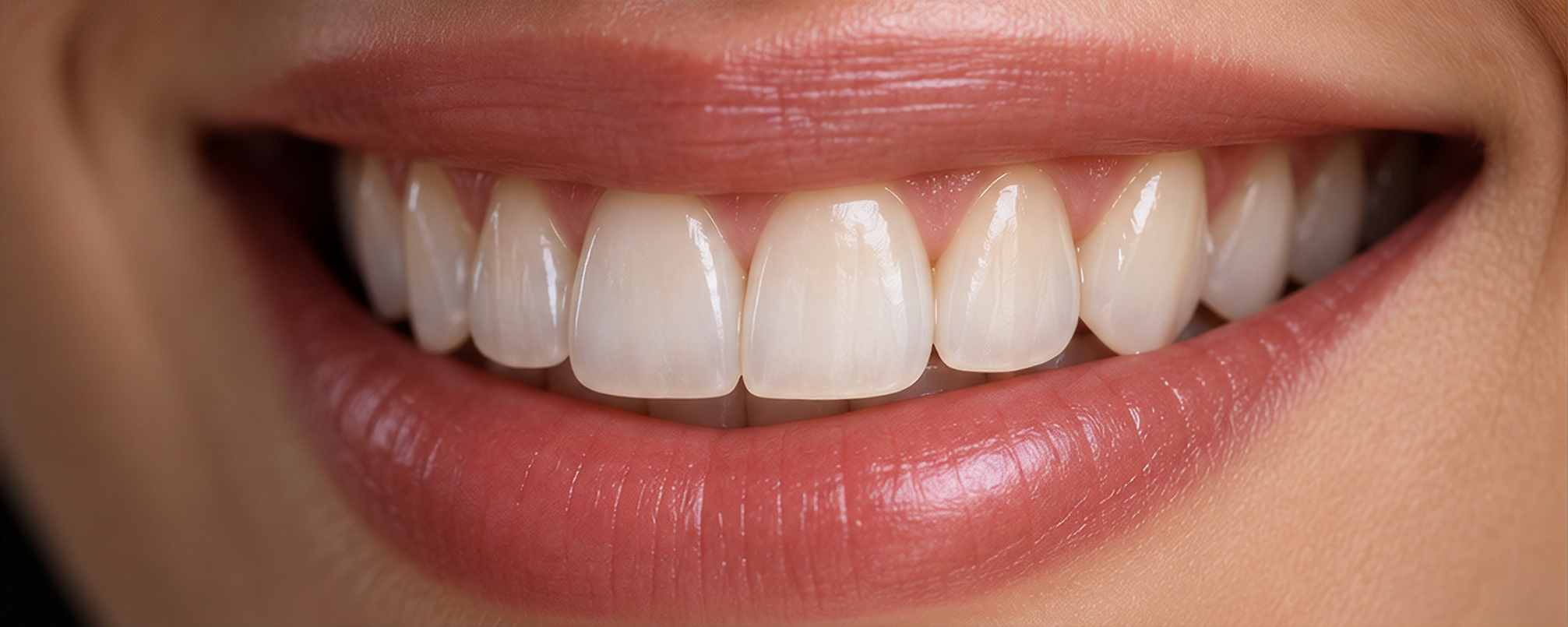
Why Natural Teeth Look Alive.
The secret to a natural-looking smile isn't simply the color of the porcelain. It's what happens when light enters it.
Every time you smile, light interacts with your teeth.
Some light reflects off the surface. Some travels through the enamel. Some scatters within the tooth, while other wavelengths are absorbed by its internal structures.
These interactions create the depth, warmth, and subtle variations in appearance that we instinctively recognize as natural.
Understanding this phenomenon is one of the foundations of sophisticated aesthetic dentistry.
What Happens When Light Meets a Tooth?
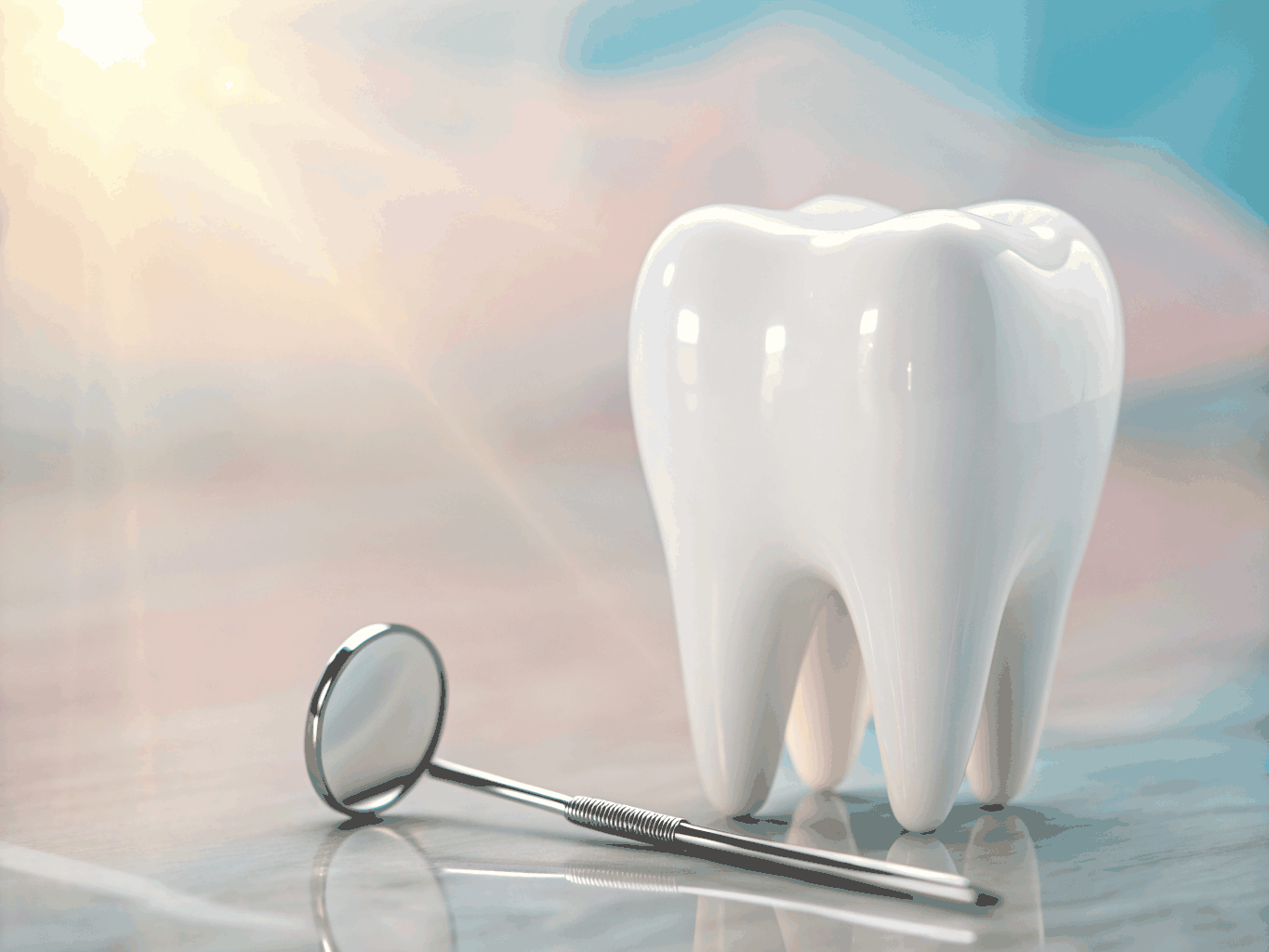
Conceptual illustration: light is reflected, transmitted, scattered, and absorbed as it interacts with enamel and dentin. Not to scale.
Reflection — What We See on the Surface
Reflection occurs when light bounces off a tooth's surface.
The amount and character of this reflection depend on surface texture, curvature, gloss, and the optical properties of the material.
Natural enamel contains subtle surface anatomy that influences the way highlights appear as the tooth moves under light.
When porcelain is excessively smooth, improperly contoured, or optically flat, its reflections can look unnatural.
Hand-finished porcelain can reproduce the fine texture and surface characteristics that give natural teeth their distinctive appearance.
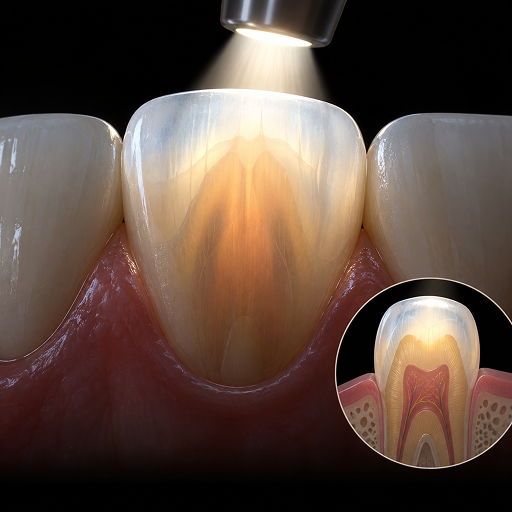
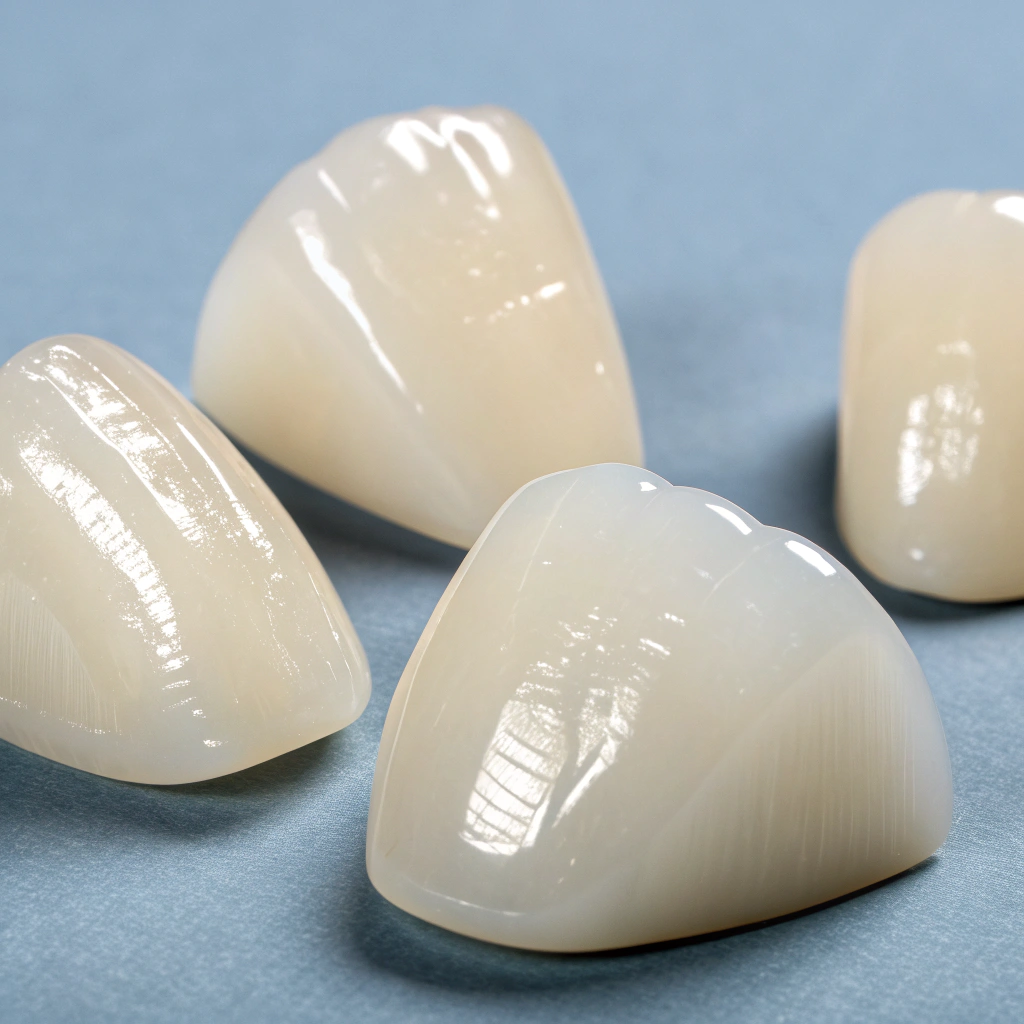
Micro-anatomic texture governs how surface highlights disperse across natural enamel curvature.
Transmission permits light to penetrate ceramic and illuminate underlying anatomical depth.
Transmission — Allowing Light to Travel Through
Light transmission refers to the passage of light through a material.
Natural enamel is partially translucent, meaning that some light can penetrate it rather than being completely reflected or blocked.
Ultra-thin feldspathic porcelain can be highly translucent, allowing light to interact with the underlying tooth structure.
This can help preserve the visual depth and natural color variations that are difficult to achieve with highly opaque restorations.
The ceramic does not simply sit on top of the tooth as a uniform white covering. When carefully selected and bonded, it can become part of a layered optical system that includes the porcelain, resin cement, enamel, and dentin.
Absorption — Creating Depth and Warmth
As light travels through natural tooth structure, certain wavelengths are absorbed.
Enamel and dentin do not interact with every wavelength equally. Their optical properties influence the color and brightness we perceive.
Dentin contributes much of a natural tooth's underlying color, while enamel modifies how that color is seen.
Translucent porcelain can allow some of this underlying color to contribute to the final appearance.
The result can be a restoration that appears to possess depth from within rather than color applied only to its surface.
Importantly, natural-looking veneers are not simply those that absorb the most light. Their appearance depends on achieving an appropriate balance of absorption, scattering, transmission, and reflection.
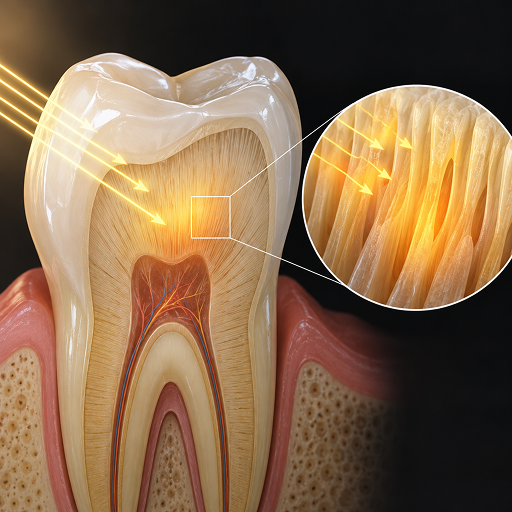
Selective absorption within internal dentin creates warmth rather than flat external pigment.
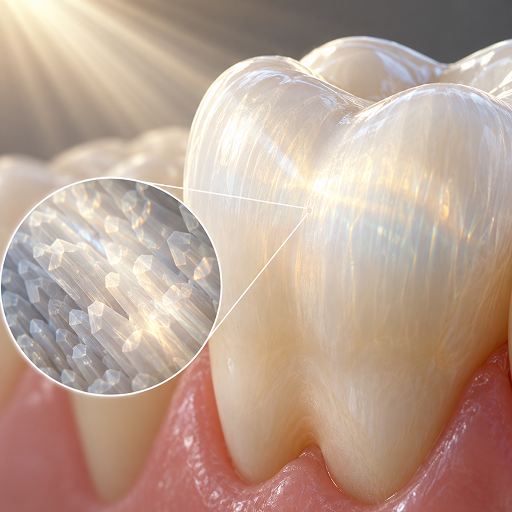
Internal micro-crystalline scattering diffuses light, giving living enamel its characteristic softness.
Scattering — The Secret to Softness
Light does not always travel through a tooth in a straight line.
As it passes through enamel, it encounters microscopic structures that redirect its path.
This process, known as light scattering, helps explain the soft, complex appearance of natural teeth.
Appropriately selected ceramic powders and internal layering techniques can create similar optical effects in porcelain.
Instead of appearing as a single uniform shade, the restoration exhibits subtle differences in brightness, translucency, and color.
This is one of the characteristics that separates sophisticated ceramic artistry from a restoration that merely matches a shade guide.
Why Some Veneers Look Opaque or Artificial
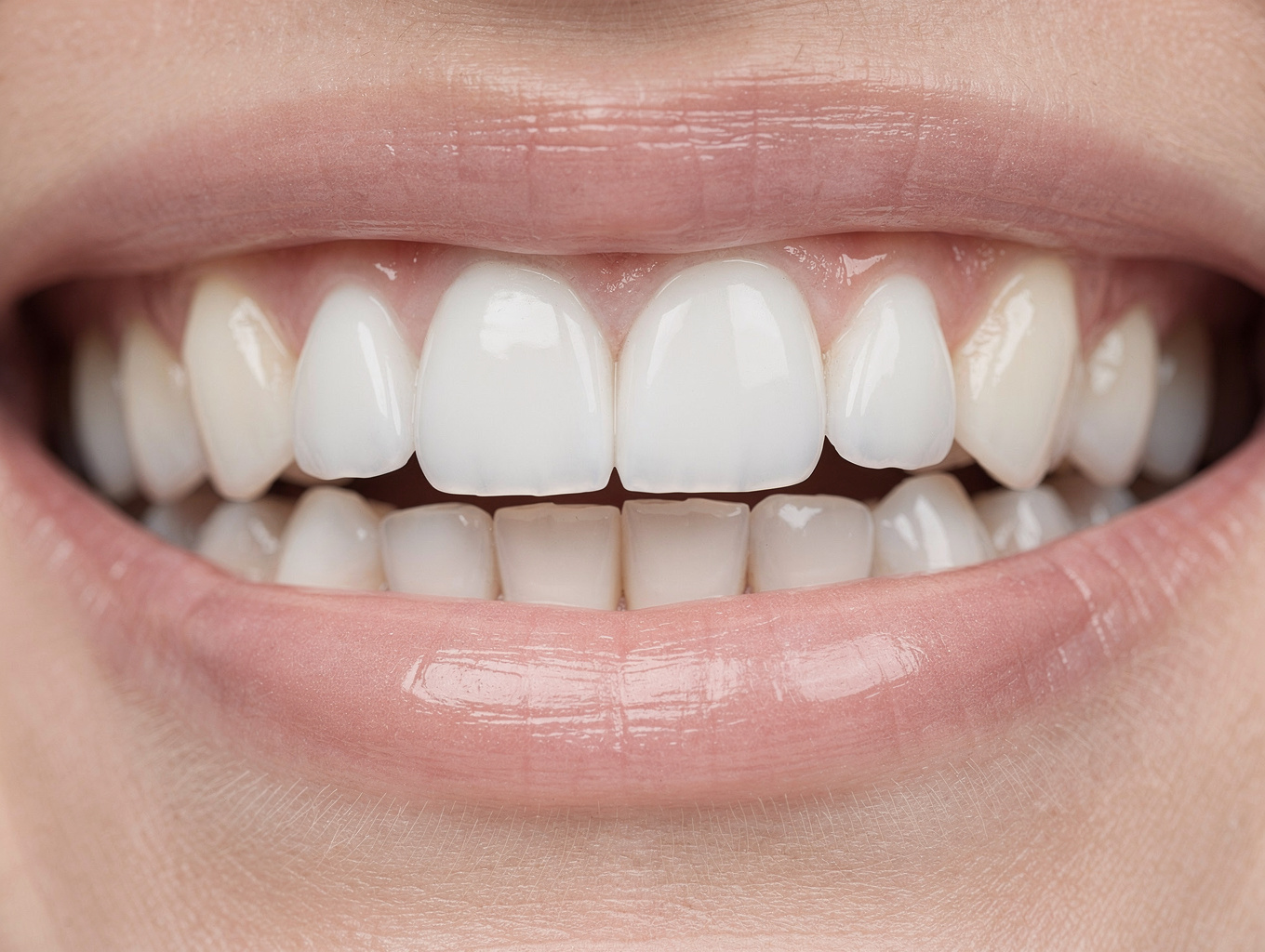
An overly opaque appearance
Uniform brightness and limited internal color variation can make teeth appear flat or artificial.
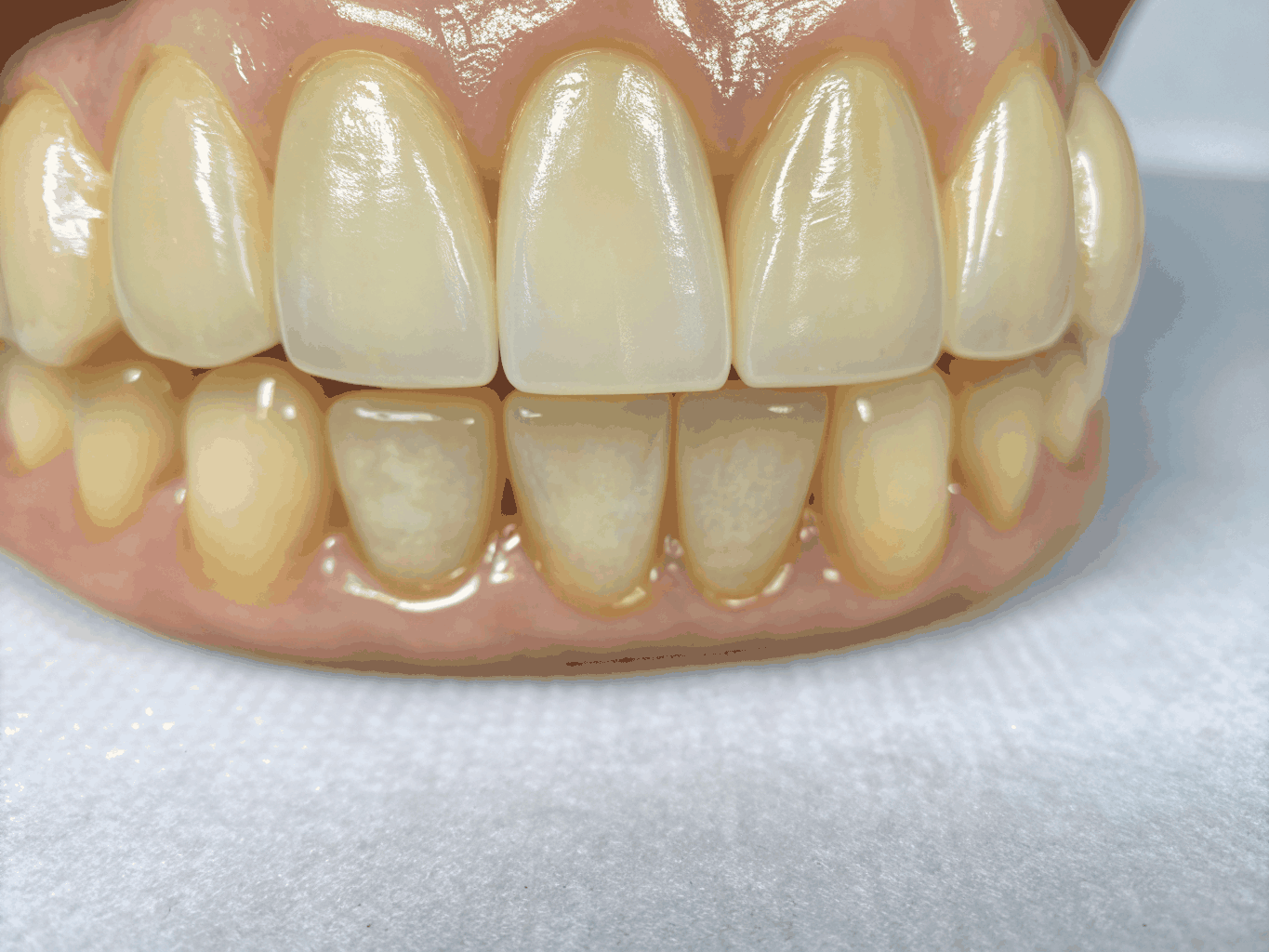
A natural, translucent appearance
Subtle gradations of color, translucency, texture, and light reflection create visual depth.
These images illustrate aesthetic concepts, not a controlled clinical comparison of ceramic materials.
Opaque porcelain can be useful when the underlying tooth is severely discolored or when a restoration needs to mask an existing substrate.
However, excessive opacity can reduce the contribution of the natural tooth to the final appearance.
When combined with overly uniform color, exaggerated brightness, or excessive bulk, this can produce the unmistakable look of artificial veneers.
By contrast, ultra-thin feldspathic porcelain can be designed to preserve more of the underlying tooth's optical contribution.
The goal is not to reflect more light. It is to interact with light more like a natural tooth.
Opalescence: The Subtle Blue and Amber of Natural Enamel
Look closely at the edges of natural front teeth.
You may notice delicate blue-gray effects, translucent areas, or warm amber highlights.
These characteristics are partly related to a phenomenon known as opalescence.
Natural enamel scatters shorter wavelengths of visible light differently from longer wavelengths. This can contribute to bluish reflected effects and warmer transmitted effects.
A skilled ceramic artist can reproduce aspects of this phenomenon using carefully selected translucent and opalescent porcelain powders.
These subtle details are often nearly invisible when viewed individually.
But together, they help create a tooth that looks authentic in different lighting conditions.
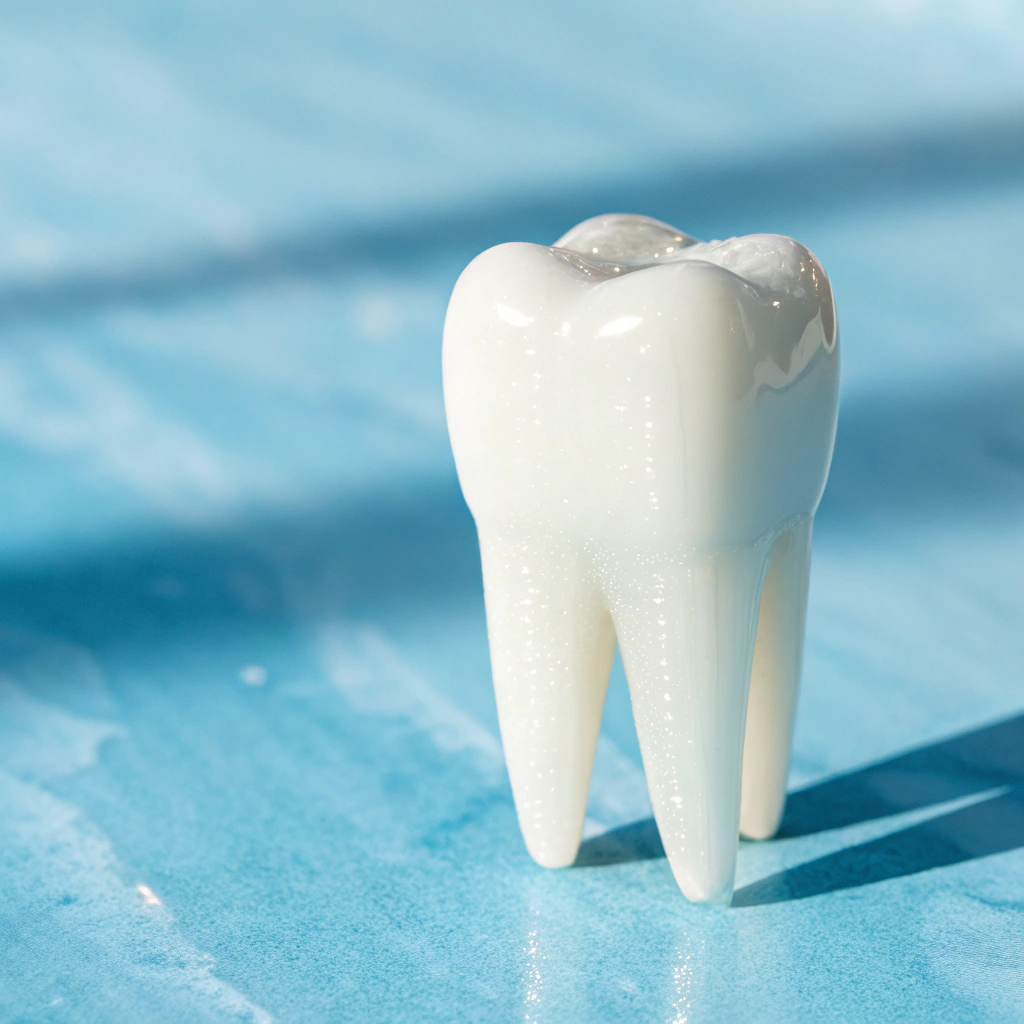
Fluorescence: Why Teeth Look Different Under Certain Lighting
Natural teeth also exhibit fluorescence.
When exposed to ultraviolet light, tooth structures can absorb energy and emit visible light, contributing to their appearance in certain lighting environments.
Dental ceramics vary in their fluorescent properties.
Carefully selected feldspathic ceramics can be formulated to reproduce aspects of natural dental fluorescence, helping restorations maintain a harmonious appearance under different light sources.
Fluorescence is one of several optical properties that a skilled dental ceramist may consider when creating highly individualized restorations.
“Natural Beauty Is a Relationship With Light.”
The most lifelike veneers are not defined by whiteness alone. They are defined by the way porcelain, underlying tooth structure, and light work together to create depth, vitality, and harmony.
A Smile Designed Around You.
Consult with our team to discover how ultra-thin feldspathic porcelain can elevate your smile with quiet precision and natural beauty.