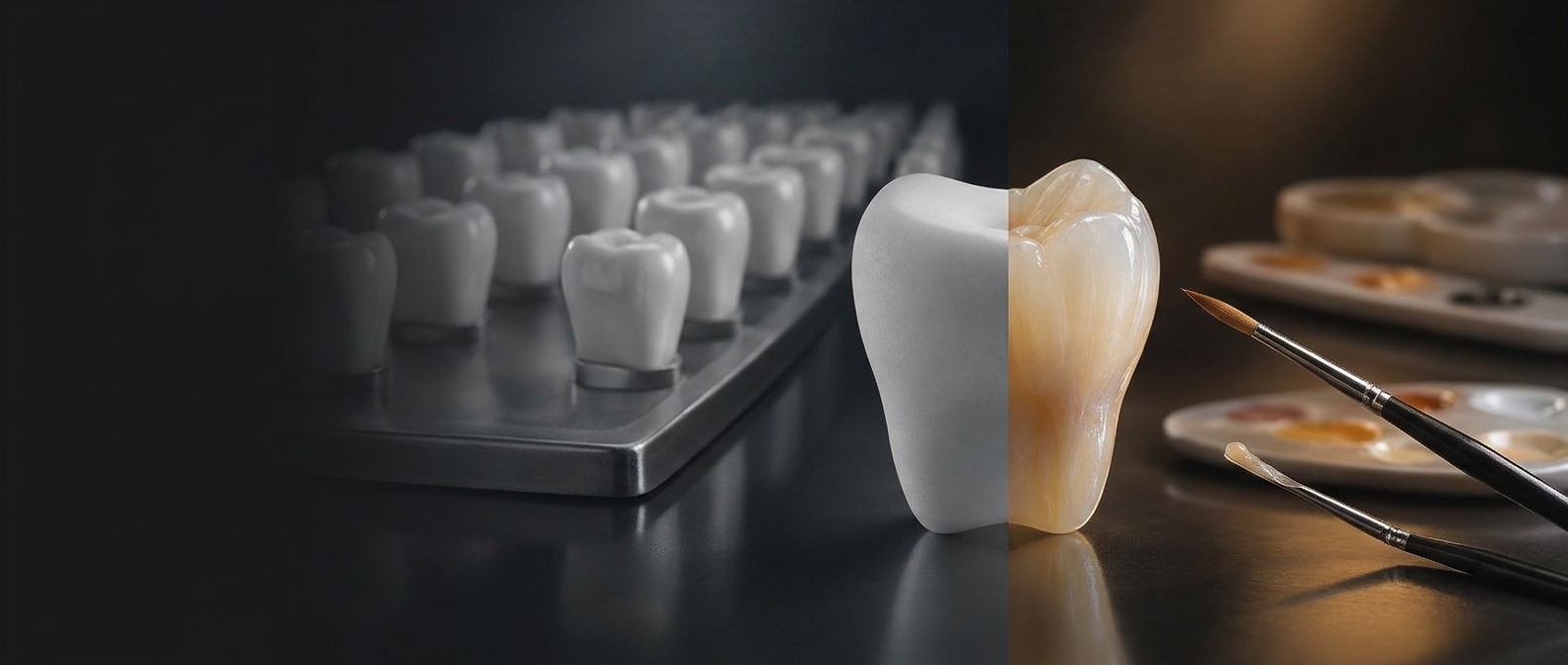
Not Manufactured. Meticulously Crafted.
There is a profound difference between creating a tooth-shaped restoration and recreating the beauty of a natural tooth.
Built Through an Artistic Process
A sequence of precise laboratory firings and individual characterization.
Each layer has a purpose. Some contribute warmth. Others create translucency, brightness, depth, or the subtle optical effects seen near incisal edges.
Feldspathic porcelain has a long history in aesthetic dentistry because of its ability to reproduce delicate optical characteristics, subtle color variations, and fine surface details.
Unlike a restoration produced primarily by milling a ceramic block, traditionally hand-layered feldspathic veneers are built through an artistic process.
A master dental ceramist applies specialized ceramic powders and liquids in carefully controlled layers, shaping the internal structure of the restoration to mimic natural enamel and dentin.
The porcelain is fired, refined, characterized, and finished through a sequence of precise laboratory steps.
Each layer has a purpose.
Some contribute warmth. Others create translucency, brightness, depth, or the subtle optical effects seen near the incisal edges of natural teeth.
The finished restoration is more than a uniform shade of white.
It is a carefully composed ceramic structure designed to recreate the visual complexity of a real tooth.
The Human Touch
In an increasingly digital world, there is something extraordinary about craftsmanship that still depends on the trained human eye.
A skilled ceramist studies how light travels through teeth, how natural enamel reflects highlights, and how subtle irregularities contribute to beauty.
No two natural teeth are exactly alike.
Their internal colors, contours, translucencies, and surface textures differ from person to person—and even from tooth to tooth within the same smile.
Hand-layered porcelain allows these details to be thoughtfully individualized.
Digital technology can improve planning, communication, and precision. But the artistic interpretation of a natural smile remains an essential part of creating truly lifelike restorations.
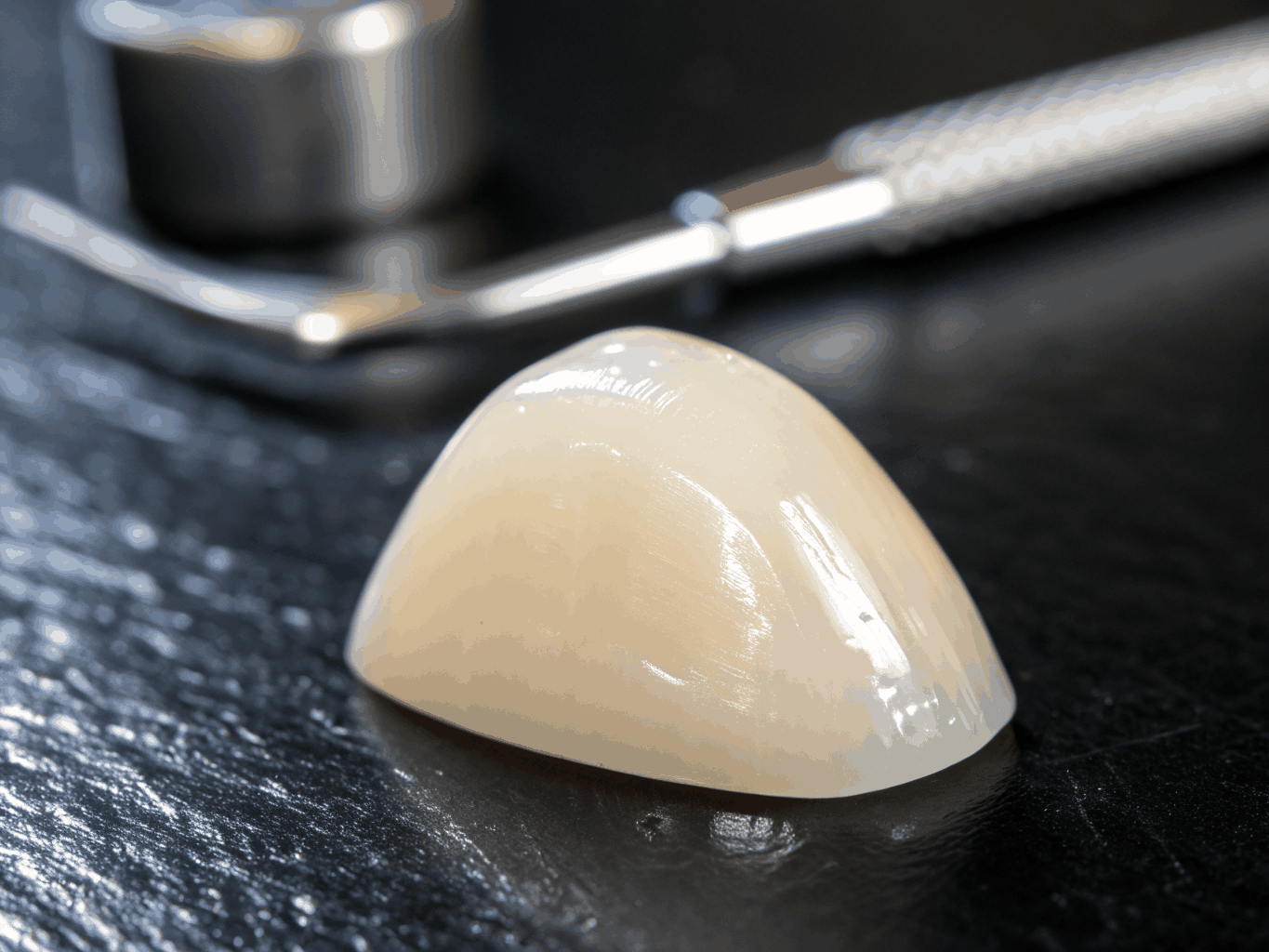
Ceramic Studio Craft
Individualized internal shade gradations and hand-sculpted surface texture.
What Makes Feldspathic Veneers Different?
A detailed examination of how hand-layered feldspathic porcelain behaves optically and biologically.
| Characteristic | Hand-layered feldspathic porcelain |
|---|---|
| Thickness | Can be fabricated at approximately 0.2–0.7 mm in selected cases |
| Translucency | Can closely reproduce natural enamel-like optical effects |
| Color | Allows detailed internal shade and translucency characterization |
| Surface texture | Can be customized to resemble natural enamel |
| Bonding | Can achieve reliable adhesive bonding with appropriate technique and enamel support |
| Main limitation | Thin ceramics require careful case selection, sufficient support, and precise bonding |
Is Feldspathic Porcelain Better Than E.max?
Not necessarily. Both can produce beautiful, natural-looking restorations.
Lithium disilicate ceramics, including e.max, offer greater flexural strength and can be manufactured in different translucencies. They may be preferable when additional strength, different preparation geometry, or more substantial shade correction is needed.
Feldspathic porcelain is particularly appealing when the clinical situation permits an extremely conservative, highly characterized restoration supported by healthy enamel.
The best material is not necessarily the strongest, thinnest, or most translucent. It is the material that best balances aesthetics, biology, function, and longevity for the individual patient.
A Smile Designed Around You.
Consult with our team to discover how ultra-thin feldspathic porcelain can elevate your smile with quiet precision and natural beauty.